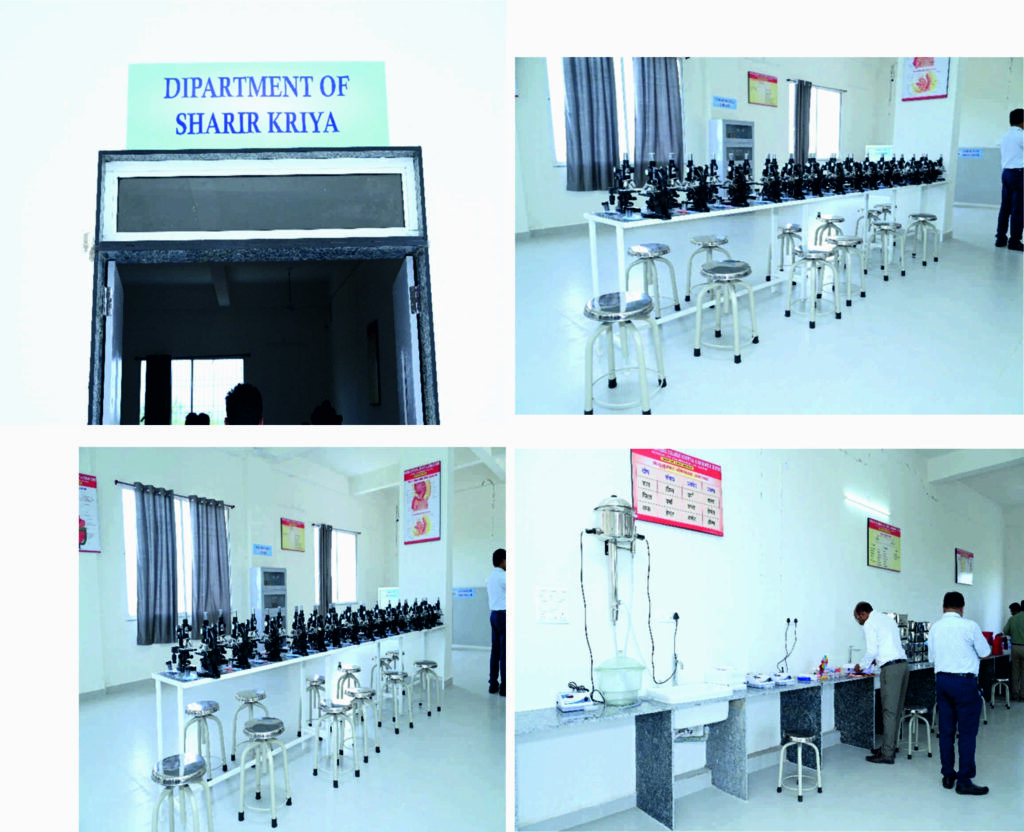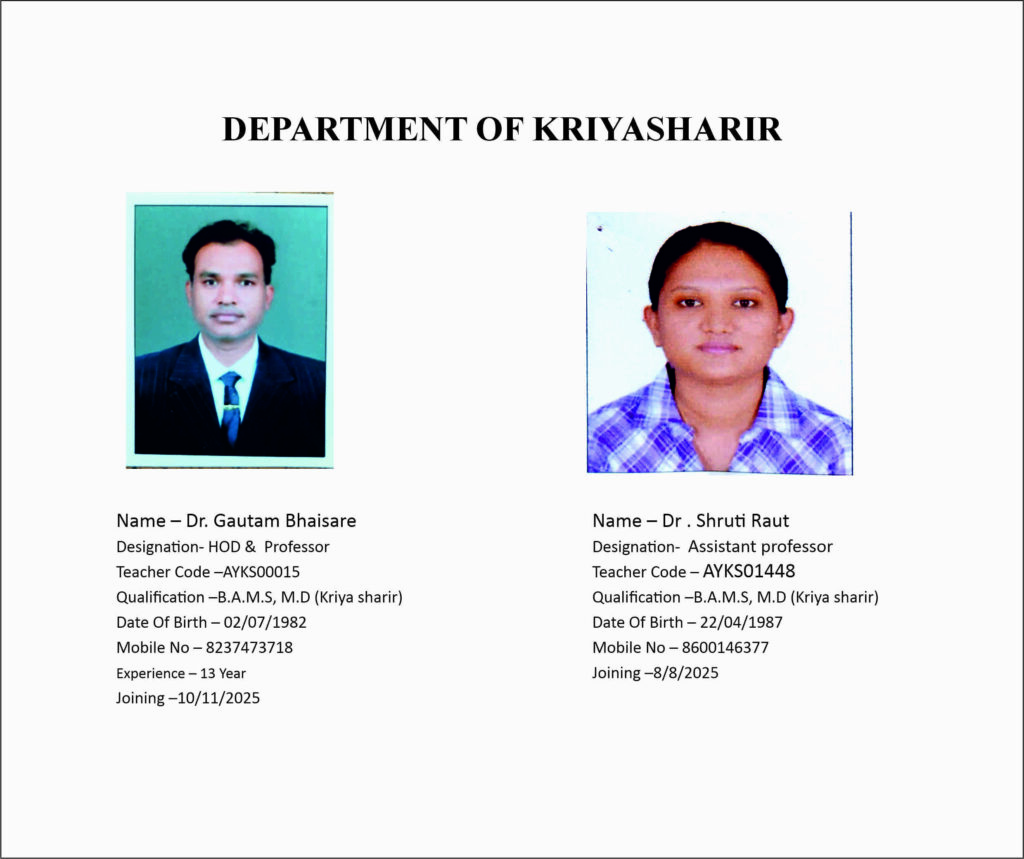
Vision
To become a center of excellence in teaching, learning, and research of Ayurvedic physiology (Kriya Sharir) by preserving classical Ayurvedic principles and integrating them with contemporary biomedical science for holistic healthcare education.
Mission
- To enable students to understand Dosha, Dhātu, Mala, Agni, Srotas, and Kriyä Käla and their role in maintenance of health and pathogenesis of disease.
- To correlate Ayurvedic physiological concepts with modern physiology for better comprehension and clinical applicability.
- To promote student-centric teaching-learning methods, including seminars, tutorials, practical demonstrations, and self-directed learning.
- To inculcate ethical values, professionalism, and lifelong learning among students in accordance with the goals of Ayurvedic education.
Course Outcomes
At the end of the course, the student will be able to:
- Describe and explain the fundamental principles of Kriyä Sharir, including Dosha, Dhatu, Mala, Agni, and Srotas, as per classical Ayurvedic texts.
- Understand and correlate Ayurvedic physiological concepts with modern physiology to develop integrative knowledge of human body functions.
- Explain Prakrti, Sara, Samhanana, Pramana, Satmya, and Ähära-Vihara and their role in maintenance of health.
- Apply the principles of Kriya Sharir in clinical examination and interpretation of physiological variations in health and disease.
- Demonstrate practical skills related to physiological assessment, including pulse, respiration, digestion, metabolism, and excretory functions as per Ayurvedic concepts.
- Develop analytical, critical thinking, and research-oriented skills in understanding Ayurvedic physiology.